


Article by Fulvio Julita
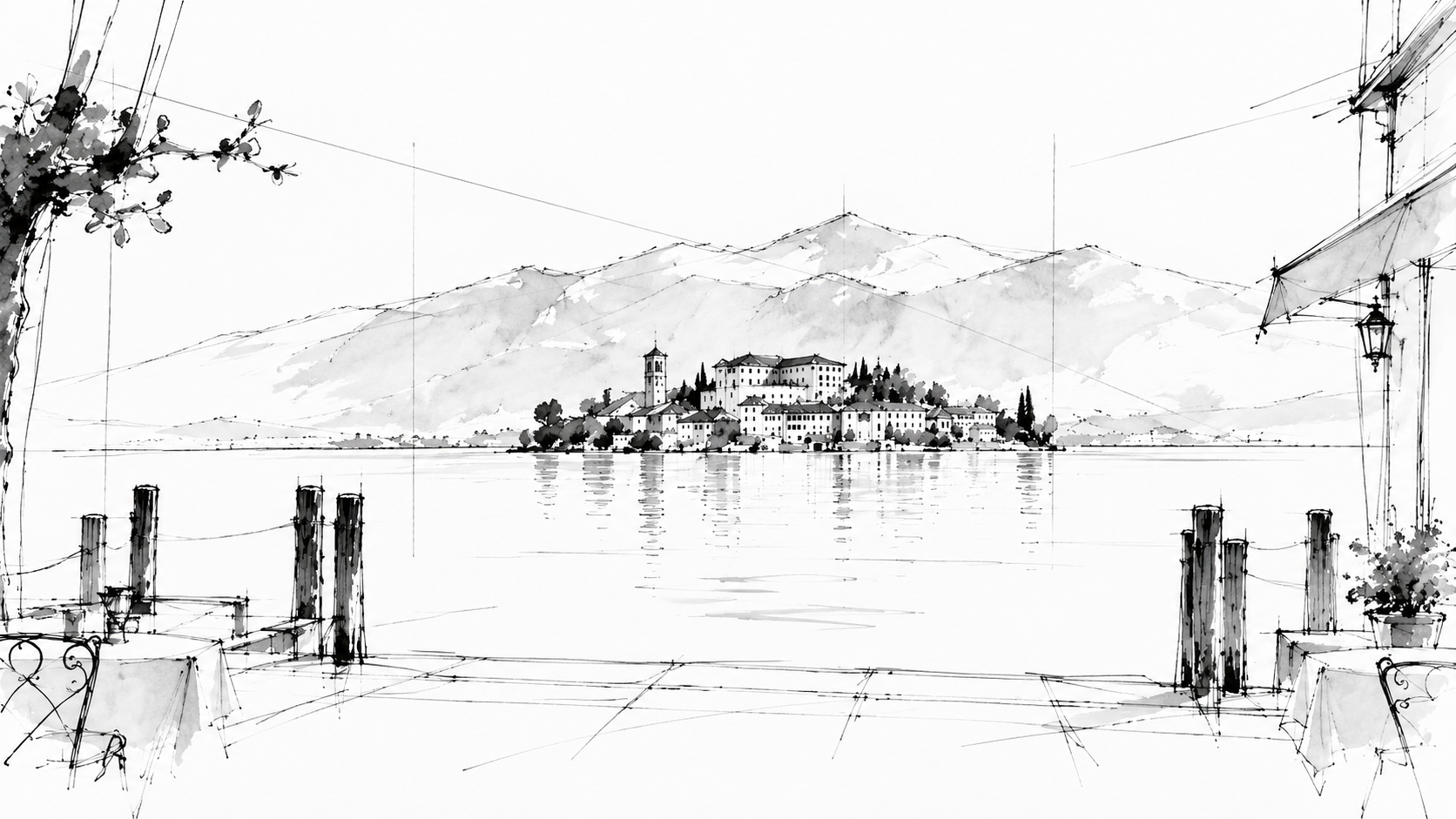
There’s a path on the Isola di San Giulio that can be walked in two directions: one way it’s called the Path of Silence, the other the Path of Meditation. Those two names alone say what Lake Orta asks of anyone who visits it: not an itinerary to follow by the clock, but a day meant to breathe.
To our guests who ask us for something different — a more intimate, more romantic experience, still waiting to be discovered — we always recommend Lake Orta. It’s a small lake, gathered around a single island, that reveals itself slowly rather than all at once.
Towards Orta, With a Stop for the Eyes
From Agrate Conturbia, the road passes close to Gozzano and its lakeside beach, one of the best known on the lake. We keep it in mind for the return journey, for anyone who would like to end the day by the water.
Orta San Giulio: The Village That Slows Down Your Thoughts
The heart of the day is Orta San Giulio, the village that gives the lake its name. We suggest leaving the car outside the centre and walking to Piazza Motta, the village’s living room: arcades, cafés, and, straight ahead, the first view of the island. In the paved lanes climbing up from the square you’ll find Baroque palaces, wrought-iron balconies and the curious Casa dei Nani, named for the tiny windows on its upper floor.
The Isola di San Giulio
Boats leave the square for the island: the crossing takes only a few minutes, but it’s enough to change the mood entirely. It’s there, along the single path that circles the island, that you walk the Path of Silence we mentioned earlier — and it’s worth walking it slowly, without stopping to photograph every view. At the centre of the island, the Basilica di San Giulio, of Romanesque origin, holds the remains of the saint who, according to legend, freed the island from serpents in the fourth century; beside it, a Benedictine abbey of cloistered nuns still keeps the silence of its rule today.
The Sacro Monte di Orta: Twenty Chapels in the Woods
Back in Orta, the climb up to the Sacro Monte is short but well worth every step. The complex, a UNESCO World Heritage Site along with the other Sacri Monti of Piedmont and Lombardy, gathers twenty frescoed chapels set in centuries-old woodland, dedicated to the life of St Francis of Assisi. From the clearings between one chapel and the next, views open up over the lake and the island that are worth the climb on their own.
Omegna, the City of Rodari
From Orta, it’s worth continuing north to Omegna, at the opposite end of the lake. It’s the birthplace of Gianni Rodari, one of the most beloved children’s writers of twentieth-century Italy, translated into dozens of languages around the world. The city is home to the Parco della Fantasia, a literary park spread across the town, and a museum next to his childhood home, with a multimedia exhibit designed for adults and children alike.
But Omegna also hides a small geographical oddity that Rodari must have loved: the Nigoglia, the stream that flows out of the lake and, instead of heading south like almost every other outflow from the pre-Alpine lakes, runs north, towards the mountains — its waters eventually reaching Lake Maggiore by way of the Strona and then the Toce rivers. An old dialect saying, still written today on the town hall, reads: “La Nigoeuja la va in su; e la legg la fèm nu” — the Nigoglia flows uphill, and we make our own laws. Rodari quotes it in the closing pages of his novel Twice Upon a Time There Was a Baron Named Lamberto, set right on the Isola di San Giulio: a small thread linking the lake, the rebellious stream, and the writer who spent his life teaching children to think against the current.
The Belvedere of Madonna del Sasso
Leaving Omegna, the road back towards Orta can take a detour uphill: the Sanctuary of Madonna del Sasso, above the village of Boleto, known locally as “the balcony of the Cusio.” From the square in front of the church, the view opens onto the whole lake and, on clear days, the Alps: it’s the highest point of the day, in every sense.
Pella, the Last View of the Lake
Heading back down towards the shore, you reach Pella, a small village on the western side of the lake, less well known than Orta but no less beautiful: a quiet little harbour, houses facing the water, and one last view of the island from an angle quite different from the one the day began with.
The Way Back
From Pella, the road heads south again, passing once more through Gozzano and its beach, before heading back to Villa Selva, in Agrate Conturbia. It’s a short day in terms of kilometres, but a long one in another sense: the time you allow yourself for each thing.
The Itinerary at a Glance
| Time | Stop |
|---|---|
| 08:30 – 09:15 | Departure from Villa Selva towards Orta San Giulio, passing through Gozzano (approx. 30 km) |
| 09:15 – 10:30 | Stroll through the village of Orta San Giulio (Piazza Motta, Casa dei Nani) |
| 10:30 – 12:00 | Crossing to and visit of the Isola di San Giulio |
| 12:00 – 13:30 | Lunch in Orta San Giulio |
| 13:30 – 14:30 | Climb up to the Sacro Monte di Orta |
| 14:30 – 15:00 | Drive to Omegna (approx. 9 km) |
| 15:00 – 16:15 | Visit Omegna (Parco della Fantasia, Museo Rodari, the Nigoglia) |
| 16:15 – 16:45 | Drive to the Sanctuary of Madonna del Sasso (approx. 15 km) |
| 16:45 – 17:15 | Stop at the belvedere |
| 17:15 – 17:45 | Descent to Pella |
| 17:45 – 18:15 | Stroll through Pella, aperitivo with lake views |
| 18:15 – 19:00 | Return to Villa Selva, passing through Gozzano |